Applications
Mutton Cloth for Woodworking: How to Wipe Sawdust, Apply Stain and French Polish
How to use mutton cloth for wood stain, French polish and sawdust, from a mutton cloth manufacturer and supplier in India. Free samples available.
On this page
- 01 Why mutton cloth works well on wood
- 02 How to wipe sawdust before finishing
- 03 How to apply wood stain evenly
- 04 How to French polish with a mutton cloth pad
- 05 How to apply oil and wax finishes
- 06 Natural or bleached mutton cloth for woodworking?
- 07 ⚠️ Store oily rags safely
- 08 Buying mutton cloth direct from the manufacturer
- 09 Buy mutton cloth from a manufacturer and supplier you can rely on
You've spent hours sanding a tabletop smooth. You wipe on the stain, step back, and see it: blotchy patches, a stray fibre trapped in the finish, and a streak where the rag dragged.
The wood wasn't the problem. The cloth was.
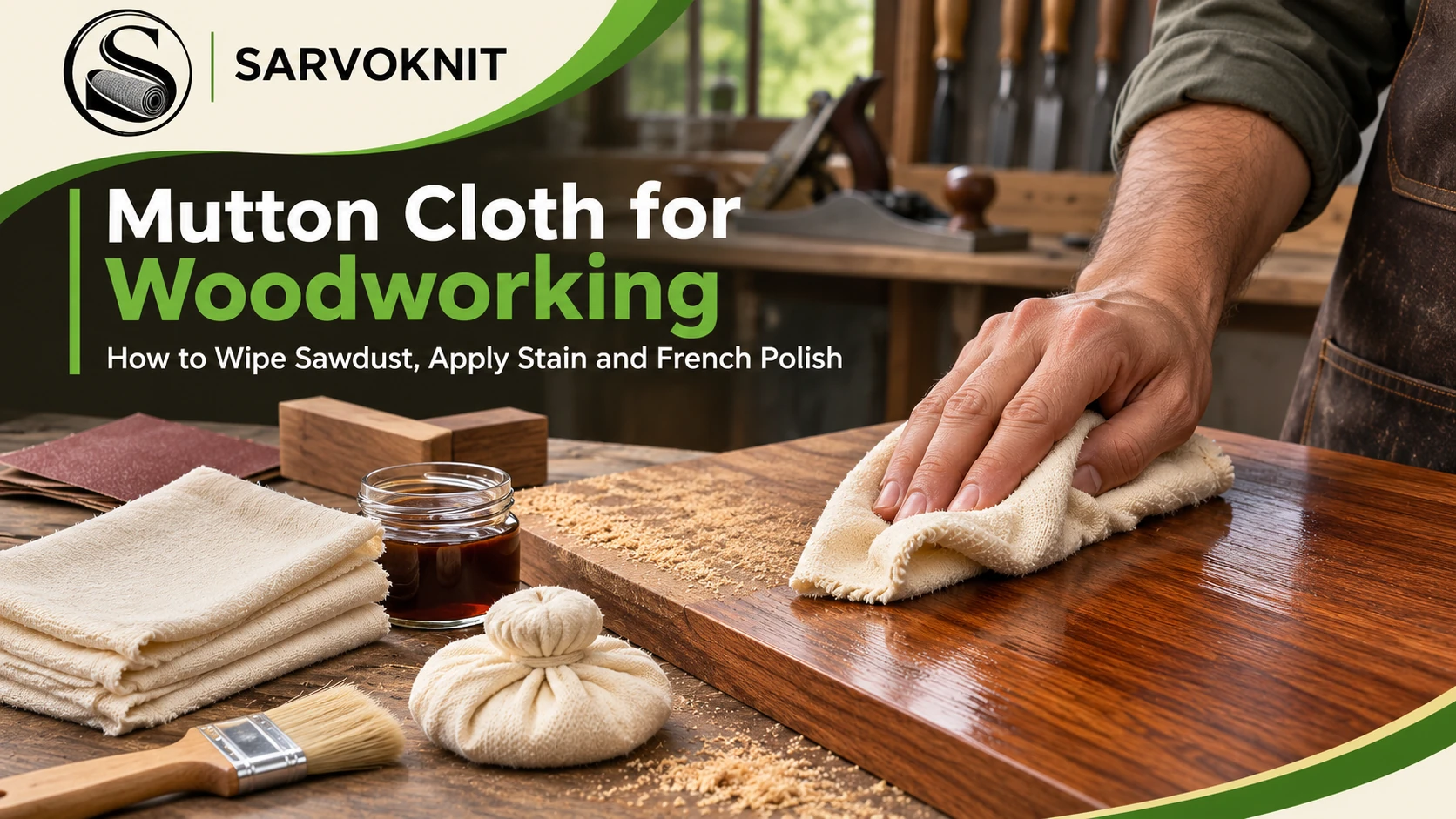
In wood finishing, the cloth touches every surface between the last sanding pass and the final coat. This guide shows you how to use mutton cloth for wood finishing: removing sawdust, applying stain evenly, French polishing, oiling and waxing, and storing oily cloths safely.
This guide comes from Sarvoknit, a mutton cloth manufacturer and supplier in Mohali, India. We knit the cloth on our own circular knitting machines and supply it in rolls, bales and cut pieces to workshops, distributors and industrial buyers in India and abroad.
Quick answer: Mutton cloth suits woodworking because it's absorbent knitted cotton that leaves very little lint, holds stain and finish without dripping, and folds into a smooth pad. Use it lightly dampened to lift sawdust, to apply and wipe off stain along the grain, as the cover of a French polishing pad, and to apply and buff oil and wax. Always store oil-soaked cloths safely, because they can catch fire on their own.
Why mutton cloth works well on wood
Mutton cloth is a cotton fabric knitted in a continuous tube. Learn more about what mutton cloth is and where it's used. Its knitted structure gives it four advantages on wood:
| Property | Why it matters on wood |
|---|---|
| Low lint | Fewer fibres end up trapped in stain, varnish or polish |
| High absorbency | It holds stain or oil and releases it evenly, without dripping |
| Soft, smooth surface | No seams, buttons or hard edges to scratch fresh finishes |
| Stretch and fold | It wraps neatly around a pad or your fingers for even pressure |
Old T-shirts and recycled rags vary from piece to piece. Some shed fibres, some carry detergent residue, and some have seams that leave marks. A consistent, new cotton cloth removes that guesswork.
How to wipe sawdust before finishing
Dust left on the surface is the most common cause of a rough finish. Even after vacuuming, fine dust sits in the grain.
- Vacuum first to remove loose dust from the surface and the pores.
- Lightly dampen a clean mutton cloth. Use water for water-based finishes, or white spirit (mineral spirits) for oil-based finishes. Wring it out well, because it should feel only barely damp.
- Wipe along the grain in long, light strokes. Don't press dust back into the pores.
- Turn the cloth often to expose a clean face.
- Let the surface dry fully before you apply stain or finish.
Tip: a damp mutton cloth makes a good alternative to a tack cloth. It lifts fine dust without the waxy residue some tack cloths leave, which can interfere with water-based finishes.
How to apply wood stain evenly
Even colour depends on applying stain consistently and removing the excess at the right time.
- Test on an offcut of the same wood first.
- Use a pre-stain conditioner on woods that blotch easily, such as pine, birch, maple and cherry.
- Fold the mutton cloth into a pad about the size of your palm.
- Load the pad moderately. It should be wet, not dripping.
- Apply generously along the grain, working one section at a time.
- Leave the stain to penetrate for the time on the manufacturer's label.
- Wipe off the excess with a clean piece of cloth, always along the grain. Darker colour comes from more coats, not from leaving stain to pool.
- Let it dry fully before the next coat or a topcoat.
Why the cloth matters here: a cloth that sheds lint leaves fibres sealed under the topcoat. A cloth that absorbs unevenly leaves light and dark patches. A tight, even knit avoids both.
How to French polish with a mutton cloth pad
French polishing builds a deep, glossy finish from many thin coats of shellac, applied with a pad called a rubber.
Making the rubber
- Take a ball of cotton wadding about the size of an egg. This is the core that holds the shellac.
- Wrap it in a square of soft, lint-free cotton, such as bleached mutton cloth. The outer cover controls how the shellac flows onto the wood.
- Twist the cover at the back to form a smooth, wrinkle-free sole on the front.
Polishing
- Charge the core with a little shellac, not the cover. Press the rubber on scrap paper until the shellac just seeps through.
- Start with straight strokes along the grain, gliding on and off the surface.
- Move to small circles and figure-of-eight strokes to build the body of the finish.
- Add a tiny drop of oil to the face of the rubber if it starts to drag. Use very little.
- Build up thin coats over several sessions, allowing drying time between them.
- Finish with straight strokes along the grain to remove swirl marks.
Tip: store the rubber in an airtight jar between sessions so it stays soft and ready to use.
How to apply oil and wax finishes
Penetrating oils such as Danish oil, tung oil and linseed oil are applied and wiped back with cloth.
Oil finishes:
- Apply a generous coat with a mutton cloth pad.
- Let it soak in for the time the manufacturer recommends.
- Wipe off all the excess with a clean cloth. Oil left on the surface turns sticky.
- Repeat for several thin coats, with drying time in between.
Wax finishes:
- Apply a thin, even layer of paste wax with a cloth pad.
- Let it haze over.
- Buff to a sheen with a clean, dry piece of mutton cloth.
Natural or bleached mutton cloth for woodworking?
| Cloth | Best for | Why |
|---|---|---|
| Bleached (white) | Staining, French polishing, final buffing | You can see how much stain or finish the cloth is carrying, which helps with even application |
| Natural | Sawdust removal, rough wiping, cleaning tools | Costs less and works well wherever colour doesn't matter |
Many workshops keep both: natural cloth for preparation and clean-up, and bleached cloth for finishing. For more on how yarn and knit quality affect lint and absorbency, read our guide to yarn, GSM and knit quality.
⚠️ Store oily rags safely
This is the most important section of this guide.
Cloths soaked in drying oils, such as linseed oil, tung oil and Danish oil, can heat up and catch fire on their own. As the oil dries it reacts with oxygen and gives off heat. In a crumpled pile of cloth, that heat can build up until the cloth ignites.
To stay safe:
- Never leave oily cloths in a heap, in a bin, or in a pocket.
- Lay them flat outdoors to dry fully, away from buildings, or
- Keep them in a closed metal container filled with water until disposal.
- Dispose of them under your local rules for oily waste.
- Follow the safety advice on the label of every finish you use.
Buying mutton cloth direct from the manufacturer
Joinery shops, furniture makers and finishing workshops get through cloth quickly. Where you buy it matters as much as how you use it.
Why buy from a manufacturer, not a trader
| Buying from a trader | Buying from a manufacturer and supplier |
|---|---|
| Stock comes from different mills, so quality can change between orders | One factory controls the yarn, knitting and inspection |
| Standard sizes only | Custom width, GSM, roll length and packing |
| An extra margin added to the price | Factory-direct pricing per kg |
| Limited answers about how the cloth is made | Direct answers from the people who make it |
What we supply for woodworking
| Option | Choices |
|---|---|
| Form | Rolls, bales or cut pieces |
| Finish | Natural, for preparation and clean-up, or bleached, for staining and polishing |
| Size | Custom width, GSM and roll length |
| Packing | Workshop bulk packs, or custom packing to your requirement |
| Supply | Free sample → trial lot → bulk order → recurring supply |
| Markets | India and export |
Tips for workshops:
- Choose rolls if you cut cloth at the bench, or cut pieces if you want ready-to-use cloths at every station.
- Keep two grades: natural for preparation and bleached for finishing.
- Track how much you use each week and set up a recurring order so you never run out mid-project.
- Test a sample on your own stains and finishes before buying in bulk.
See our standard widths, finishes and pack sizes on the cotton mutton cloth rolls page. If you're comparing options, our guide to choosing the right industrial cleaning cloth explains how mutton cloth compares with other wiping cloths. Wondering about synthetics? See mutton cloth vs microfibre cloth.
Workshops also use mutton cloth on machines and tools. Our guide to the best cloth for cleaning oil and grease from machinery covers that side of the job.
Buy mutton cloth from a manufacturer and supplier you can rely on
Sarvoknit is a mutton cloth manufacturer in India and a direct supplier to workshops, distributors and industrial buyers. We knit every roll in-house in Mohali, inspect every batch before dispatch, and hold ISO and ZED certification.
What you get when you buy direct:
- Consistent quality from one factory, order after order
- Custom width, GSM, roll length and packing for your workshop
- Natural or bleached finishes, in rolls, bales or cut pieces
- Free samples and trial lots before you commit
- Bulk and recurring supply across India and for export
Try it on your own stains and finishes first: request a free sample.
Selling to woodworkers? Hardware stores and paint shops can stock our cloth under their own brand. See private-label stockinette for distributors.