
Servoknit Insights
What Makes Mutton Cloth "Premium"? Yarn, GSM, and Knit Quality Explained
Every supplier calls their mutton cloth "premium." This guide shows you what that should really mean, from cotton yarn and GSM to knit quality, so you can judge samples with confidence and avoid costly bad batches.
Introduction
Two suppliers send you mutton cloth samples. Both are white, soft, and priced as "premium." Three weeks after your bulk order arrives, one batch is thinning at the edges, shedding fibres, and needing twice as many cloths per shift.
The label didn't tell you the difference. The yarn, GSM, and knit quality did.
This guide breaks down what actually makes premium mutton cloth premium, and how to check it yourself before you place an order.
Why "Premium" Needs a Definition
"Premium" is one of the most overused words in cleaning cloth sales. Almost every supplier uses it, and almost none explain what it means.
For a B2B buyer, premium mutton cloth should deliver three things:
- Performance: it absorbs well, stays soft, and sheds little lint.
- Durability: it holds up through heavy use and repeated washing.
- Consistency: every roll performs like the last one.
All three come down to how the cloth is made. Let's start with the yarn.
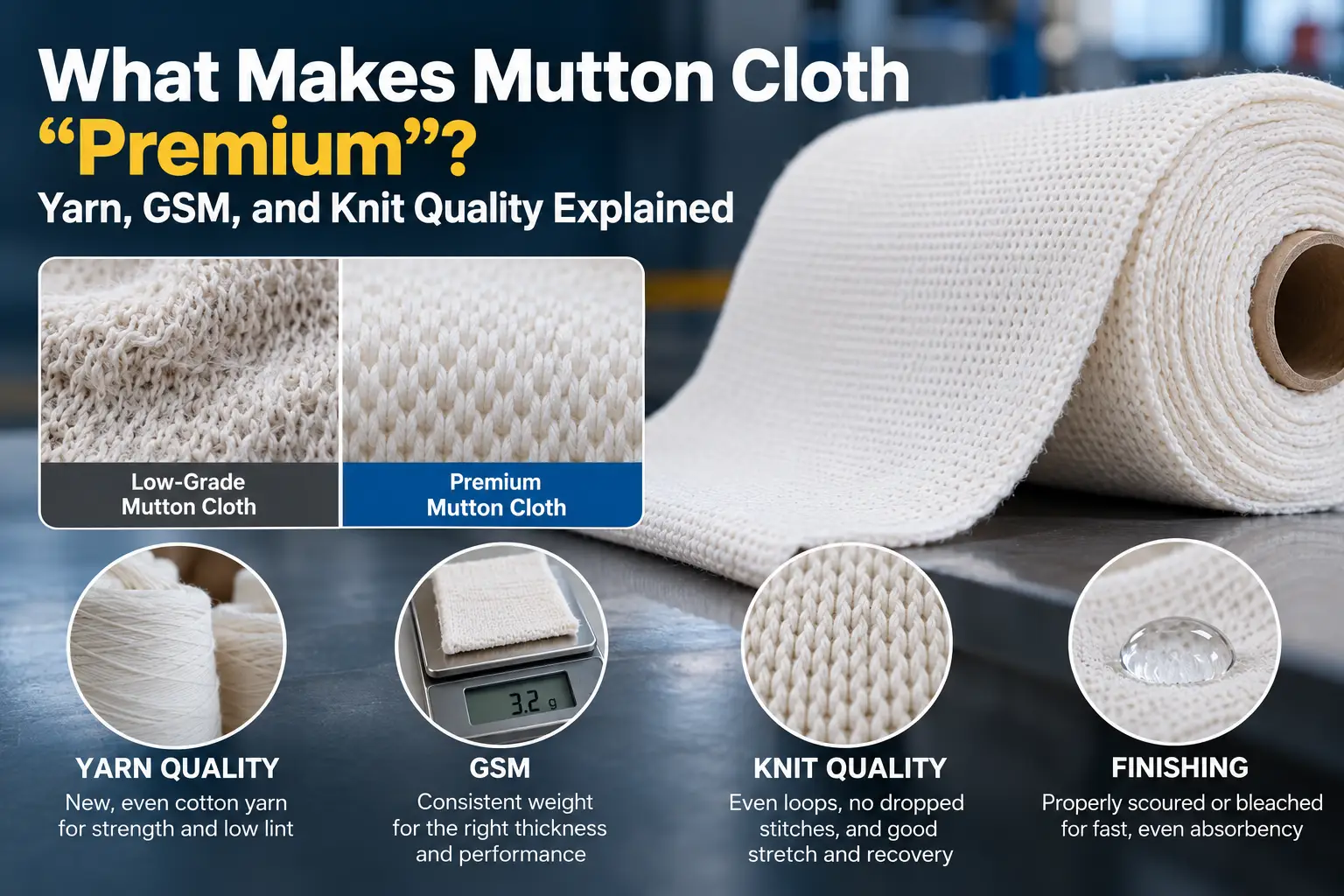
1. Yarn Quality: Where Premium Starts
The yarn is the raw material of every mutton cloth. If it's poor, no amount of good knitting can fix it.
New Cotton vs. Recycled or Waste Yarn
Premium mutton cloth is made from new cotton yarn. Some low-cost cloth uses yarn spun from textile waste or mixed fibres to cut costs.
Waste-based yarn tends to be weaker and less even. It sheds more fibres and breaks down faster in use.
Pure Cotton vs. Blends
Pure cotton absorbs water, oil, and many solvents well. It's also soft on painted and polished surfaces.
Some cheaper cloths include synthetic fibres. These have lower absorbency and can melt or smear under heat or certain chemicals. If you need a cotton cloth, confirm it's 100% cotton.
Yarn Evenness and Strength
Good yarn has a consistent thickness along its length. Uneven yarn creates thin spots that tear first and thick spots that feel rough.
Stronger, better-spun yarn also produces less loose fibre, which means less lint on your work.
Yarn Count
Yarn count describes how fine or coarse the yarn is. Finer yarns give a smoother, softer cloth suited to polishing. Coarser yarns build a thicker, tougher cloth for heavy wiping.
Neither is "better" on its own. What matters is that the yarn count matches the job, and that it stays the same from batch to batch.
2. GSM: What the Weight Tells You
GSM stands for grams per square metre. It measures how heavy, and roughly how thick, the fabric is.
What GSM Means in Practice
-
Lighter GSM: thinner, more flexible, and good for fine polishing and finishing work.
-
Medium GSM: a balanced choice for general cleaning and maintenance.
-
Heavier GSM: thicker and more absorbent, built for grease, oil, and tough industrial jobs.
Higher GSM Isn't Always Better
A heavier cloth isn't automatically premium. A high GSM made from poor yarn will still shed and fall apart.
Premium means the right GSM for your application, delivered consistently. A supplier who can't tell you the GSM of their cloth is a supplier to question.
How to Check GSM Yourself
You can check a sample with a basic digital scale:
-
Cut a 10 cm × 10 cm square from a single layer of the cloth.
-
Weigh it in grams.
-
Multiply the weight by 100.
The result is the approximate GSM. Repeat it with samples from different rolls. Large variations are a warning sign.
3. Knit Quality: The Detail Most Buyers Miss
Mutton cloth is knitted on circular knitting machines into a seamless tube. How well that knitting is done decides how the cloth behaves in use.
Even Loops and Stitch Density
In a well-knitted cloth, the loops are even and tightly packed. That gives it a smooth surface, good stretch, and strong resistance to tearing.
Loose or uneven knitting creates weak zones. The cloth stretches out of shape and develops holes sooner.
No Dropped Stitches or Holes
Dropped stitches are small gaps where the machine missed a loop. They often start as tiny flaws and grow into ladders once the cloth is pulled.
Premium cloth is inspected for these defects before it's rolled and packed.
Uniform Tube Width
The tube should be the same width along the entire roll. Uneven width suggests poor machine control. It also makes cutting and handling harder for your team.
Stretch and Recovery
Good knitted cotton stretches and then returns close to its original shape. Poor-quality cloth stays stretched, which makes it flimsy and harder to use.
4. Finishing: The Step That Affects Absorbency
After knitting, raw cotton fabric still contains natural waxes and processing oils. These block absorbency.
Proper finishing, such as scouring or bleaching, removes them. That's why a well-finished cloth soaks up liquid fast, while a poorly finished one lets water bead on the surface.
Natural vs. Bleached
-
Natural mutton cloth keeps the cotton's original tone and suits general cleaning.
-
Bleached mutton cloth has a bright white finish for jobs where cleanliness is visible.
Both can be premium. The key is that the finishing is done properly and evenly.
Premium vs. Low-Grade Mutton Cloth at a Glance
|
Feature |
Premium Mutton Cloth |
Low-Grade Mutton Cloth |
|
Yarn |
New, even cotton yarn |
Waste-based or mixed-fibre yarn |
|
GSM |
Matched to use, consistent |
Unknown or varies by roll |
|
Knit |
Even, tight loops |
Loose, uneven loops |
|
Defects |
Inspected, minimal holes |
Dropped stitches and weak spots |
|
Lint |
Low |
Noticeable shedding |
|
Absorbency |
Fast, even |
Slow or patchy |
|
Lifespan |
Lasts through repeated use |
Wears out quickly |
|
Batch consistency |
Reliable |
Unpredictable |
5 Simple Tests to Check Mutton Cloth Quality
You don't need a lab. Try these on any sample before buying in bulk.
1. The Light Test
Hold the cloth up to a light. Premium cloth looks even throughout. Thin patches, holes, or streaks show poor yarn or knitting.
2. The Water Drop Test
Place a few drops of water on the cloth. Well-finished cotton absorbs them within seconds. If the drops sit on top, the cloth hasn't been finished properly.
3. The Lint Test
Rub the cloth firmly across a dark, smooth surface. Check for loose fibres. The fewer you see, the better.
4. The Stretch Test
Pull a section gently and let go. It should spring back close to its original shape. If it stays stretched or you hear threads snap, the knit is weak.
5. The GSM Test
Use the weigh-and-multiply method above on samples from two or three rolls. The numbers should be close to each other and to what the supplier claims.
Red Flags When Buying Mutton Cloth
-
The supplier can't tell you the GSM or yarn type.
-
Samples look noticeably different from the bulk order.
-
Prices are far below the market rate with no explanation.
-
The seller trades stock but doesn't manufacture it.
-
There's no clear answer on how quality is checked between batches.
Questions to Ask Your Mutton Cloth Supplier
-
Is the cloth made from new cotton yarn or recycled fibre?
-
What GSM options do you offer, and how do you keep them consistent?
-
Do you knit the fabric in-house?
-
How do you inspect for holes and defects?
-
Do you offer natural and bleached finishes?
-
Can you customise width, roll length, and packaging?
-
Can you send samples from more than one production batch?
Request a free sample or bulk quote →