Sarvoknit Insights
How to Import Mutton Cloth from India: MOQ, Samples, Shipping & Documents
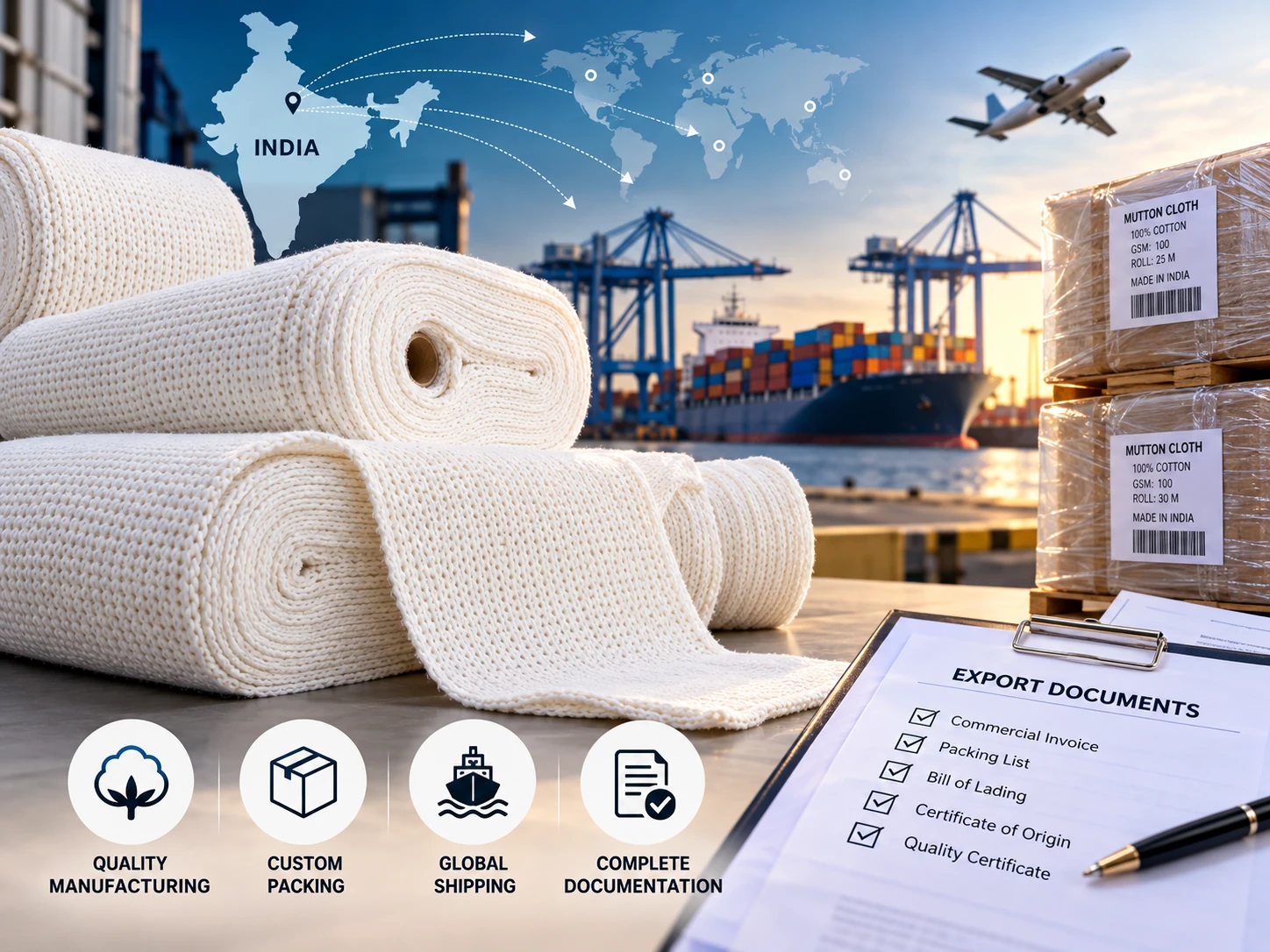
To import mutton cloth from India, buy from a manufacturer rather than a trader. Approve a courier sample against a written specification (GSM, width, roll size, finish, and packing), then agree on the MOQ, price per kg, Incoterm, and payment terms in writing. Make sure the commercial invoice, packing list, bill of lading, and certificate of origin all match. Sea freight takes roughly 1 to 6 weeks depending on your region.
On this page
- 01 Why buyers import mutton cloth from India
- 02 Manufacturer or trader: check this first
- 03 Write a clear specification
- 04 Test samples before you commit
- 05 MOQ and pricing per kg
- 06 Export packing
- 07 Shipping terms: EXW, FOB, CIF, and DAP
- 08 Export documents
- 09 Lead times
- 10 Payment terms
- 11 Why importers choose Sarvoknit
Your sample arrived soft, clean, and absorbent. Then the bulk order landed. The cloth was thinner, the rolls weighed less than invoiced, and the container sat at customs for nine days because one document didn’t match.
Most importing problems have nothing to do with the cloth. They come from questions nobody asked before the order was placed.
This guide shows you how to import mutton cloth from India safely: who you’re really buying from, what to specify, how to test samples, and how packing, documents, shipping terms, and lead times work.
Why buyers import mutton cloth from India
India has a large cotton supply and a deep knitting industry. That gives you competitive prices per kg and the capacity for regular bulk orders.
Indian manufacturers can also knit to your exact specification. For importers and distributors, that means you can build your own product range instead of reselling standard stock.
The risk is choosing the wrong supplier. Quality varies widely between factories, and even more between traders.
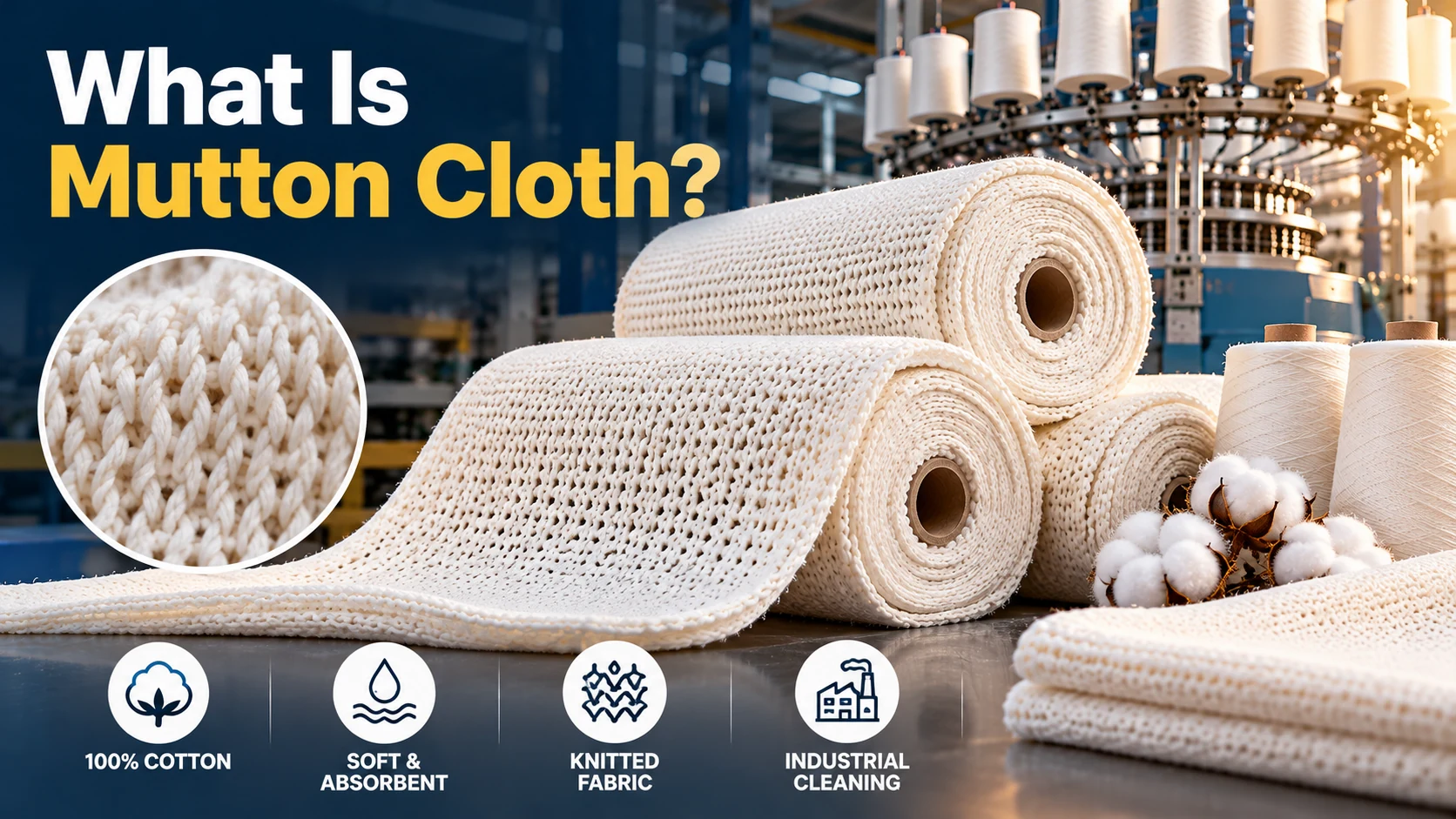
New to the fabric? Start with our guide to what mutton cloth is and where it’s used.
Manufacturer or trader: check this first
Traders buy from several mills and resell. That’s the most common reason quality changes from one order to the next.
Ask every supplier:
-
Do you knit the fabric in-house, or buy it from other mills?
-
Can you share photos or a video of your knitting machines?
-
Which certifications do you hold? Look for ISO, and for Indian MSMEs, ZED.
-
Which organisations do you already supply?
-
Can you send samples from two different production batches?
A manufacturer controls the yarn, the knitting and the inspection, so your tenth shipment matches your first.
Sarvoknit knits every roll in-house in Mohali, India. We’re ISO and ZED certified, and we supply leading Indian aerospace, defence and PSU organisations. See our certifications, team and clients on our About page.
Write a clear specification
“Mutton cloth, white, 1,000 kg” leaves too much open. A clear specification protects you when the bulk order arrives.
|
Detail |
What to state |
Our standard options |
|
Material |
100% cotton |
100% cotton |
|
GSM |
The fabric weight you need |
e.g. 100 GSM white mutton cloth; other weights to order |
|
Width |
Width in inches or cm |
8, 10, and 12 inches; wider up to 40 inches, or any width to order |
|
Roll size |
Length or weight per roll |
25 m and 30 m rolls, or to your requirement |
|
Finish |
Natural or bleached |
Both available |
|
Packing |
Rolls, cut pieces or packs |
250 g, 500 g, 1 kg, 10 kg and larger, or packed to order |
|
Labelling |
Your brand, language, barcodes |
Packed and labelled to your requirement |
Not sure which weight you need? Our guide to Mutton Cloth Premium explains yarn, GSM, and knit quality in plain terms.
Buyers in the US and some other markets search for this fabric as stockinette. Many buyers use the two names for the same knitted cotton cloth. See Mutton Cloth vs Stockinette, or our Stockinette product page.
Test samples before you commit
Never place a first bulk order without testing a sample.
Indian manufacturers usually send samples by international courier, such as DHL or FedEx. They typically arrive in 3 to 7 working days, depending on your country. Ask about the cost and timing when you request one.
Test the sample the way your customers will use it:
-
Absorbency: drop water on the cloth. Good cotton soaks it up within seconds.
-
Lint: rub it hard on a dark, smooth surface and look for loose fibres.
-
Strength: stretch it and let go. It should spring back without tearing.
-
Weight: cut a 10 × 10 cm square, weigh it in grams, and multiply by 100. That’s the approximate GSM.
Keep a piece of the approved sample. When the bulk order arrives, compare the two side by side.
Test Sarvoknit cloth before you order. Tell us your application, grade, and country, and we’ll arrange a sample.
MOQ and pricing per kg
Indian manufacturers price mutton cloth per kg. Four things set the price:
-
Yarn quality: new, even cotton yarn costs more than waste-based yarn, but sheds far less lint.
-
GSM: heavier cloth uses more cotton per metre.
-
Finish: bleaching adds a processing step.
-
Order size and packing: larger orders and simpler packing lower the price per kg.
At Sarvoknit, the MOQ depends on the grade, width, and packing you choose. Send us your quantity, and we’ll confirm the MOQ and price per kg in your quote. For a first order, ask whether grades or widths can be combined in one shipment.
Be careful with a quote far below the market. It usually means waste yarn, a lighter GSM than agreed, or rolls that weigh less than stated.
Export packing
Cotton absorbs moisture. On a long sea voyage, poor packing can leave you with damp, musty or mouldy cloth.
Agree on these points before production:
-
Inner protection: every roll or pack sealed in a poly bag.
-
Outer packing: strong cartons or pressed bales, depending on your volume and how your warehouse handles goods.
-
Labels: grade, weight, batch number, and your order number on every carton.
-
Pallets: wooden pallets must be heat-treated and stamped under the ISPM 15 standard. Many countries reject untreated wood.
-
Packing list: every carton numbered, with its net and gross weight.
Batch numbers let you trace any problem back to one production run. At Sarvoknit, every batch is inspected before dispatch, and we pack and label to your requirements.
Shipping terms: EXW, FOB, CIF, and DAP
Incoterms decide who pays for what, and where responsibility passes from seller to buyer.
|
Term |
Supplier handles |
You handle |
Best for |
|
EXW (Ex Works) |
Goods ready at the factory |
Everything from pickup |
Buyers with their own freight agent in India |
|
FOB (Free on Board) |
Delivery to the Indian port and export clearance |
Ocean freight, insurance, and import |
Experienced importers |
|
CIF (Cost, Insurance and Freight) |
Freight and insurance to your port |
Import clearance and local delivery |
First-time importers |
|
DAP (Delivered at Place) |
Delivery to your address, excluding duty |
Import duty and clearance |
Buyers who want door delivery |
Tell us which term you prefer when you request a quote. We’ll confirm the terms we can offer, the port of loading, and the route.
Sea or air?
-
Sea freight suits most bulk orders. Smaller orders ship as LCL, sharing a container; larger orders as FCL, a full container.
-
Air freight takes days instead of weeks but costs far more per kg. Use it for urgent restocks or small first orders.
Export documents
Missing or mismatched documents are the most common cause of customs delays. Your supplier should provide:
-
Commercial invoice: buyer, seller, product description, HS code, quantity, unit price, and total value.
-
Packing list: carton count, net and gross weights, and dimensions.
-
Bill of lading for sea freight, or air waybill for air: proof of shipment and ownership.
-
Certificate of origin: proves the goods were made in India. If your country has a trade agreement with India, it may lower your import duty.
-
Certificates: ISO and ZED certificates on request, for tenders and regulated buyers.
About HS codes: knitted cotton fabric on rolls usually falls under heading 6006. Cut, finished cleaning cloths often fall under 6307.10. Ask your customs broker to confirm the code for your country before shipping, because it sets your duty rate.
Check that the description, weight, and value match on every document. One small mismatch can hold a shipment at the port.
Lead times
Your total lead time has three parts:
-
Production: depends on grade, quantity, and packing. Standard widths are usually faster than custom specs. We confirm production time in writing with your quote.
-
Inland transport and export clearance: usually a few days to reach the port.
-
Transit: sea freight takes roughly 1 to 2 weeks to the Gulf, 3 to 5 weeks to Europe, and 4 to 6 weeks to North America. Air freight takes a few days.
Add a buffer for port congestion and holidays. For regular supply, agree on a monthly schedule so new stock ships before you run low. Sarvoknit has the capacity for recurring and large-volume orders.
Payment terms
Common terms for first orders from India:
-
Advance payment (T/T): full or part payment by bank transfer before dispatch.
-
Part advance, balance against documents: for example, 30% upfront and 70% when you receive copies of the shipping documents.
-
Letter of credit (L/C): your bank pays when the agreed documents are presented. It’s safer for large orders but adds bank fees.
We confirm payment terms with your quote. Only pay into the bank account named on the supplier’s official invoice, and confirm any change of account by phone.
Planning an import order? Send us your country, grade, and quantity. We’ll reply with a price per kg and your shipping options.
Pre-order checklist
Before you confirm the order:
-
Supplier confirmed as an in-house manufacturer
-
Courier sample tested and approved, with a piece kept
-
Written specification for GSM, width, roll size, finish, and packing
-
MOQ, price per kg, and payment terms agreed in writing
-
Incoterm and port of loading agreed
-
HS code checked with your customs broker
-
Export packing and carton labels agreed
-
Production and dispatch date confirmed in writing
Why importers choose Sarvoknit
-
In-house manufacturer: we knit every roll ourselves, so quality doesn’t depend on someone else’s mill.
-
Trusted by demanding buyers: a supplier to leading Indian aerospace, defence and PSU organisations.
-
Certified: ISO and ZED certified, and a registered MSME.
-
Made to your spec: width, weight, roll length, finish and packing.
-
Inspected before dispatch: we check every batch, so each shipment matches your approved sample.
Send us your country, grade, and quantity. Our team works Monday to Saturday, 9 am to 6 pm IST.